
Peruvian Birds: The 7 Winged Guardians of the Peruvian Skies
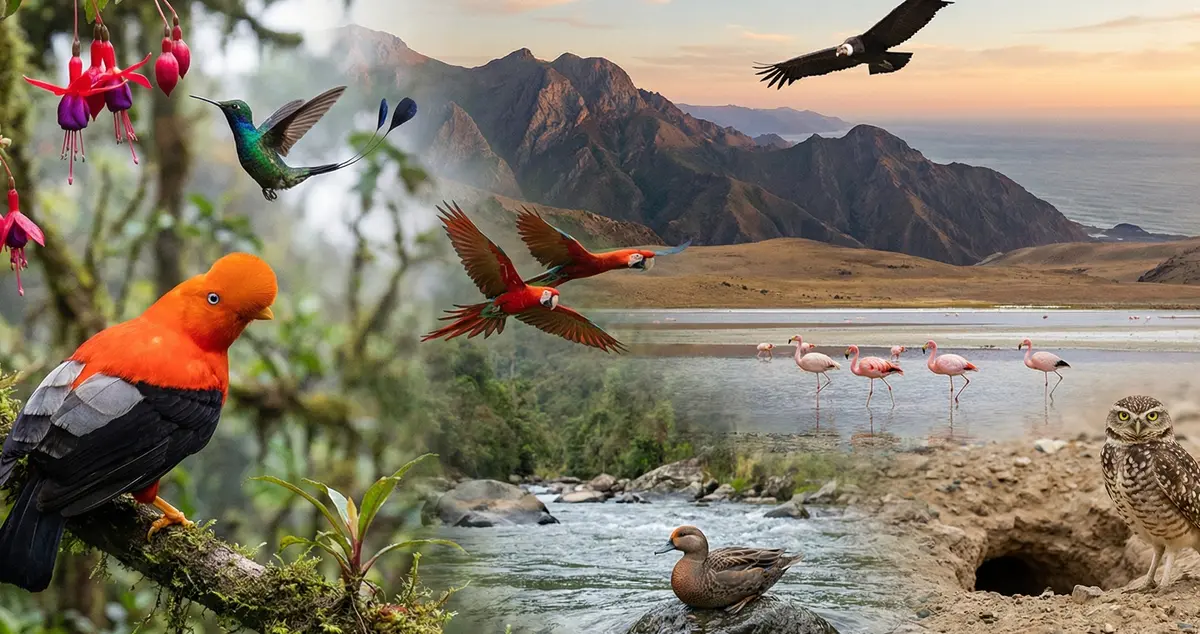
Peru is not merely a country of ancient history and fascinating archaeology; it is, above all, a sanctuary of life. When biologists and naturalists speak of this territory, they do so with reverence, referring to it as one of the world’s epicenters of biodiversity. In this vast geographical stage, which twists from the depths of the marine trench to the snowy peaks and descends toward the Amazon, Peruvian birds hold a place of honor. They are the winged witnesses to the evolution of a dramatic and diverse landscape.
With a registry exceeding 1,800 species, the country holds the title of being one of the best destinations on the planet for ornithology. However, one does not need to be an expert with long-range binoculars to appreciate this richness. From the casual traveler to the professional photographer, everyone is captivated by the color, behavior, and majesty of Peruvian birds. In this article, we will take an exhaustive journey through the national geography via its seven most iconic representatives, exploring not only their biology but their soul and their importance to the balance of the natural world.
Peru: An Evolutionary Laboratory for Avifauna
To understand why there are so many unique Peruvian birds, we must first look at the map. The Andes mountain range acts as a backbone that divides and creates microclimates. To the west, the cold Humboldt Current bathes the coast, creating a nutrient-rich marine ecosystem; to the east, the humidity of the Atlantic is trapped, generating the densest rainforest in the world.
This variety of habitats has allowed evolution to take creative paths. Species have specialized in astounding ways: beaks designed for specific flowers, wings adapted for high-altitude thermal currents, and plumage that defies any painter’s palette. Studying Peruvian birds is, in essence, studying the geological history of the South American continent.
“Birdwatching” has ceased to be a scientific niche and has become a tool for conservation and economic development. Every time a tourist arrives seeking to see the Andean Cock-of-the-rock or the Condor, value chains are activated that protect forests and educate local communities on the value of keeping Peruvian birds alive in their natural environment.
1. The Andean Cock-of-the-rock: The Dancer of the Cloud Forests
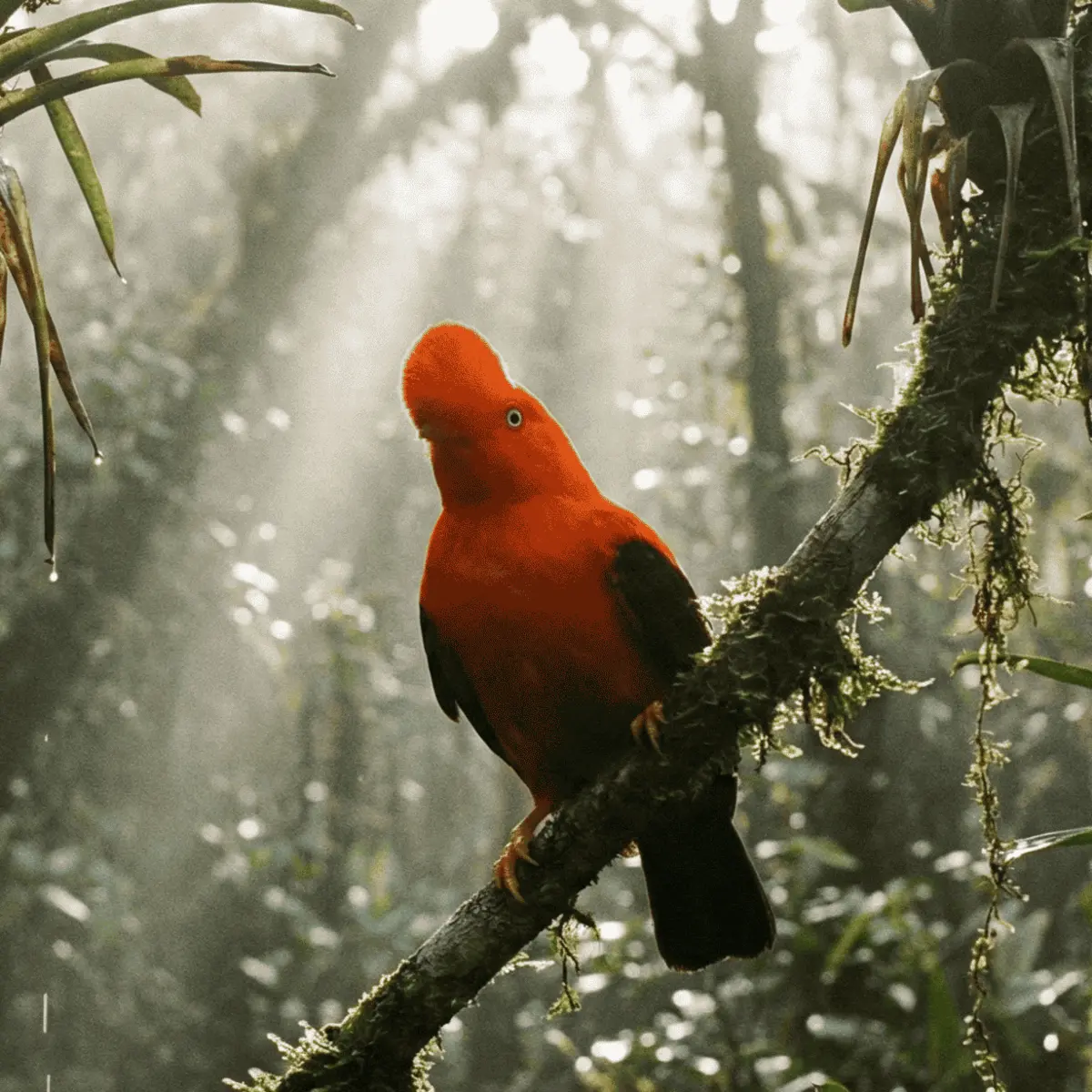
If there were a contest to define extravagance in nature, the Andean Cock-of-the-rock (Rupicola peruvianus) would be a serious contender for first place. Designated as the National Bird of Peru, this species is the soul of the humid montane forests, those transition zones between the Andes and the low jungle where fog is eternal and trees are covered in orchids and bromeliads.
The Dance of Life in the Lek
What makes this species truly special is not just its incredible incandescent orange color (in males), but its social behavior. Males congregate in spaces called “leks,” natural stages where they compete to attract females, who possess a much more discreet brown color to camouflage themselves in nests.
Witnessing the courtship of the Andean Cock-of-the-rock is one of the most coveted experiences when seeking Peruvian birds. The males jump, emit guttural sounds, and display their disk-shaped crests, creating a visual and sonic spectacle that resonates through the thick of the forest. This behavior is vital for the genetic selection of the species, ensuring that only the strongest and healthiest specimens pass on their genes.
Ecological Importance
Beyond its beauty, the Cock-of-the-rock is a forest gardener. By feeding on wild fruits and dispersing seeds through its droppings, it actively contributes to the regeneration of flora in cloud forests. Without its presence, the vegetal structure of these ecosystems, which are vital water sources, would be compromised.
2. The Andean Condor: Lord of the Hanan Pacha
No list of Peruvian birds would be complete without mentioning the absolute monarch of the South American skies: the Andean Condor (Vultur gryphus). For the Inca worldview, the condor was not just an animal, but a divinity. It represented the Hanan Pacha, the world above, and was believed to be the messenger between the gods and men.

Living Aerodynamics
With a wingspan that can exceed three meters, the condor is one of the largest flying birds in the world. Its mastery lies not in constant flapping, but in gliding. Taking advantage of the rising thermal currents generated in deep canyons, such as the Colca in Arequipa or the Apurímac, the condor can ascend thousands of meters while barely expending energy. Watching it spiral up until it becomes a black dot in the blue sky is a lesson in physics and biology.
An Misunderstood Role
Often unjustly feared by ranchers, the condor is a strict scavenger. Its ecological function is that of a “cleaner.” By consuming dead animals, it prevents the proliferation of bacteria and diseases that could affect other animals and even humans. The conservation of this species is critical, as its reproduction rate is very slow (they lay one egg every two years), making them extremely vulnerable. Protecting the condor means protecting the sanitary balance of the puna, representing one of the most significant efforts in the conservation of Peruvian birds.
3. The Marvelous Spatuletail: The Jewel of the Utcubamba Valley
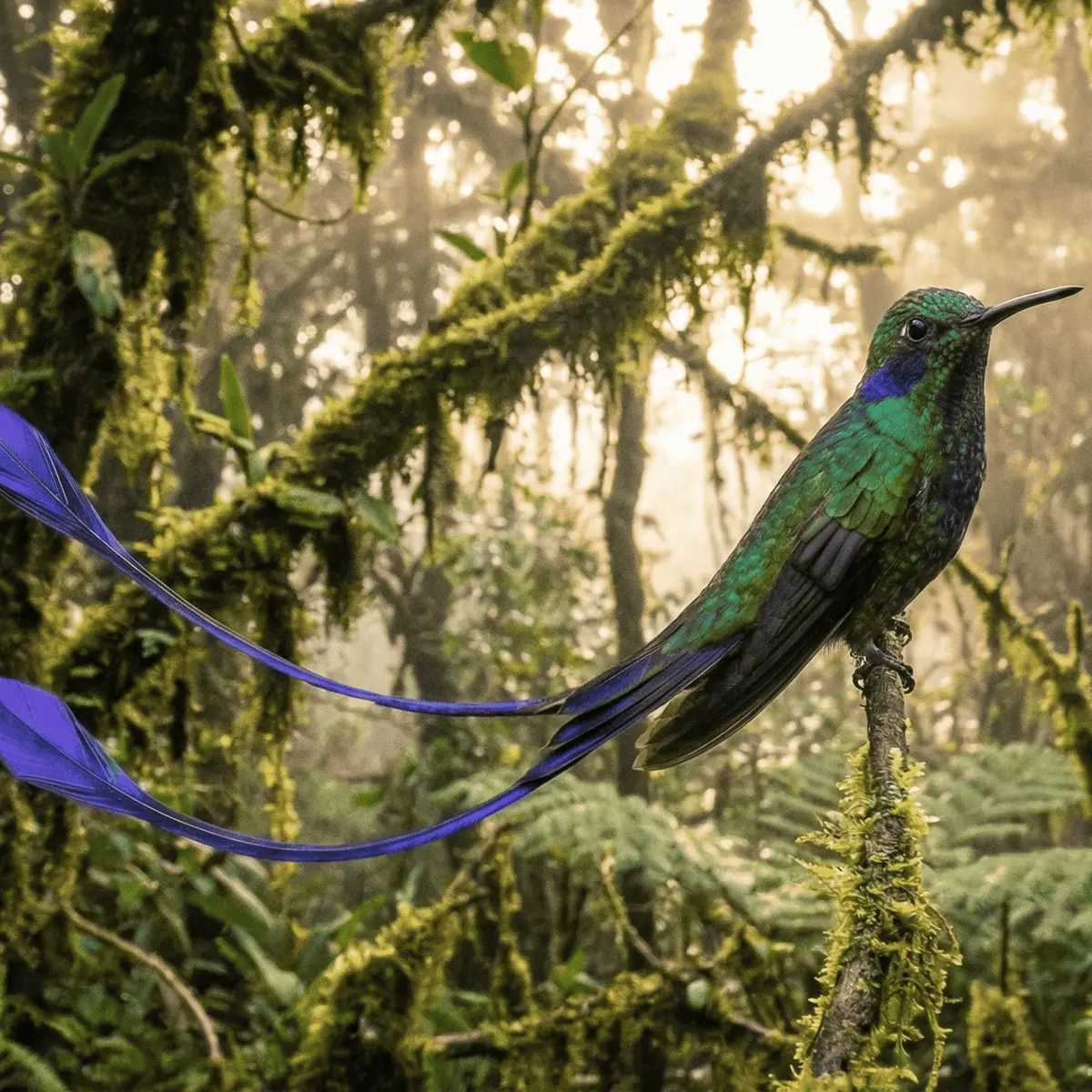
In northern Peru, specifically in the Utcubamba River basin (Amazonas), lives a creature that seems to have come out of a fairy tale. The Marvelous Spatuletail (Loddigesia mirabilis) is an endemic species, meaning it is found nowhere else on the planet. It is, without a doubt, one of the rarest and most charismatic Peruvian birds.
A Tail Unique in the World
The defining characteristic of this hummingbird is, as its name suggests, its tail. The male possesses only four tail feathers, two of which are incredibly long, thin, and end in iridescent violet discs that he can move independently. During courtship, the male vibrates these discs while hovering in front of the female, in a display of agility and color that defies human sight.
The Challenge of Conservation
Due to its restricted distribution range, the Marvelous Spatuletail is endangered. Deforestation for agriculture has fragmented its habitat. However, local initiatives have created private reserves where residents plant specific flowers that feed this bird, demonstrating that Peruvian bird watching tourism can be the engine to save a species from extinction. Traveling north to see it is not just tourism; it is an act of direct support for its survival.
4. Macaws and Parrots: The Explosion of Color in the Amazon
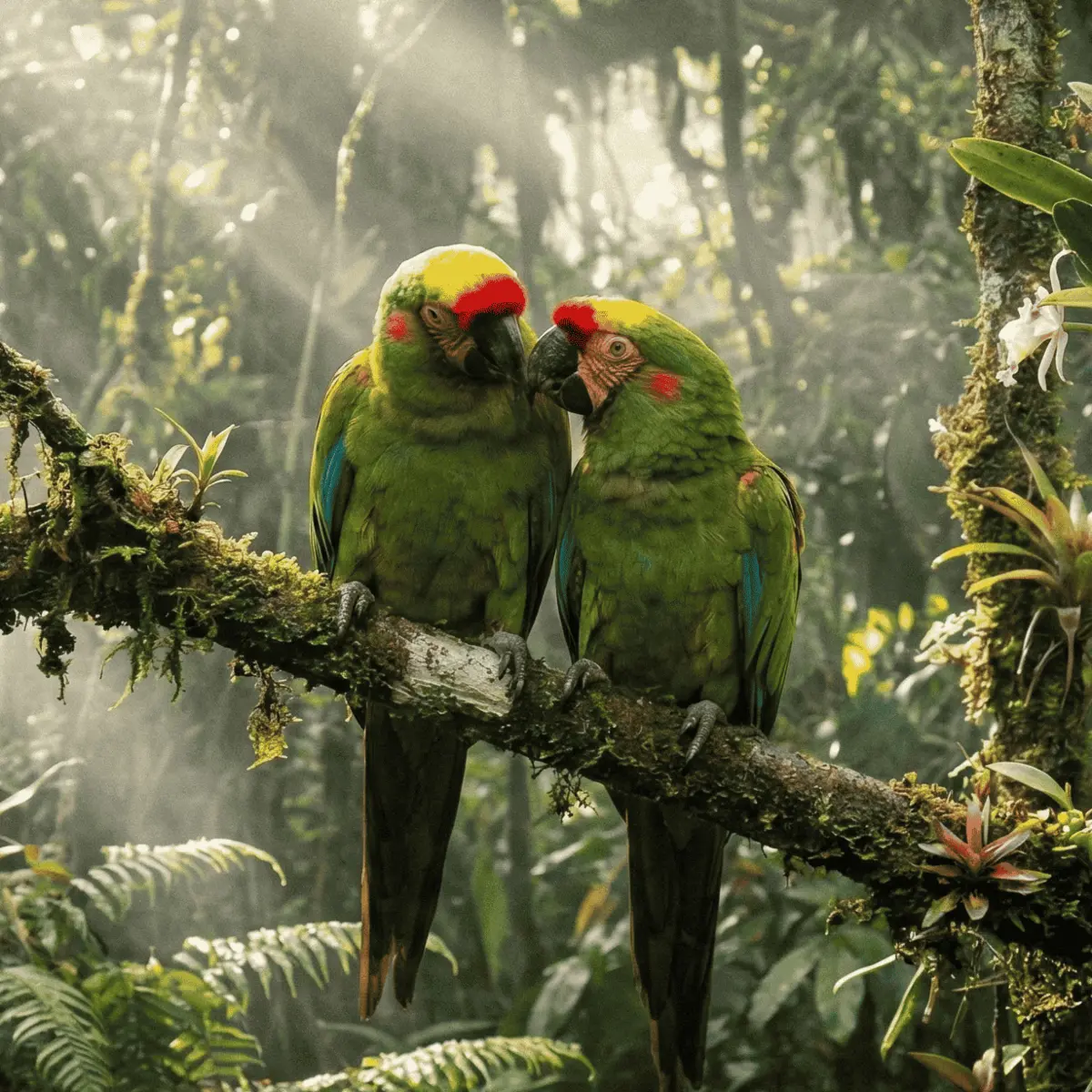
Although the user mentioned the “Red-fronted Macaw” (a species more associated with Bolivia), in the context of Peruvian birds, the undisputed equivalent in majesty and ecological role are the large Macaws (such as the Ara macao or Scarlet Macaw, and the Red-and-green Macaw). These birds are the living symbol of the tropical Amazon rainforest.
The Phenomenon of the Clay Licks (Colpas)
One of nature’s most impressive spectacles occurs at the clay licks in the Tambopata National Reserve and Manu National Park. Every morning, hundreds of macaws, parrots, and parakeets descend in a cacophony of screams and colors to eat clay. Scientists believe this behavior helps Peruvian birds of the jungle detoxify their bodies from chemical substances present in the green seeds they consume, in addition to providing them with vital sodium.
Intelligence and Loyalty
Macaws are known for their intelligence and for forming monogamous pairs that usually last a lifetime. Seeing a pair of red macaws flying across the forest canopy is observing an unbreakable bond. Unfortunately, their beauty has been their curse, making them frequent victims of illegal wildlife trafficking. Responsible observation of these Peruvian birds in their wild habitat is the best way to combat the black market, demonstrating that a macaw is worth more flying free than in a cage.
5. The Andean Flamingo: Elegance in the Heights
When we think of flamingos, we imagine tropical beaches, but Peru breaks that mold with the Andean Flamingo or Parihuana (Phoenicoparrus andinus). This bird inhabits the brackish lagoons and wetlands (bofedales) of the high mountains, at more than 3,000 meters above sea level, in regions such as Puno, Ayacucho, and Arequipa.

Inspiration for a Nation
History tells that the liberator José de San Martín, upon landing in Paracas, saw a flock of flamingos with red wings and white chests take flight, inspiring him to create the first flag of Peru. Thus, the Parihuana is intrinsically linked to national identity, being one of the Peruvian birds with the greatest historical and symbolic load.
Extreme Adaptation
Living in the altiplano is not easy. Solar radiation is extreme and nights are freezing. However, the Andean Flamingo thrives here thanks to its ability to filter microscopic algae and diatoms from alkaline waters. Its long legs and curved beak are tools of evolutionary precision. Seeing a colony of thousands of flamingos dyeing a high-Andean lagoon pink, with snow-capped volcanoes in the background, is one of the most surreal postcards that Peruvian birds offer.
6. The Torrent Duck: The Master of Whitewater
While most ducks prefer tranquil lagoons, the Torrent Duck (Merganetta armata) is an adrenaline junkie. It inhabits fast-flowing rivers and whitewater that descend from the Andes toward the jungle and the coast. It is one of the Peruvian birds with the greatest physical specialization for its environment.

Swimming Against the Current
Watching a Torrent Duck defies logic. They are seen swimming powerfully against currents that would drag a human away, diving into the foam to search for insect larvae attached to submerged rocks. They possess an aerodynamic body, large feet, and a stiff tail they use as a rudder.
They are biological indicators of water quality; they only inhabit clean, oxygenated rivers. Therefore, their presence is good news for the ecosystem. Often, travelers trekking to Machu Picchu or in the Sacred Valley can spot them jumping from rock to rock, demonstrating the incredible tenacity of Peruvian birds.
7. The Burrowing Owl: Sentinel of the Desert
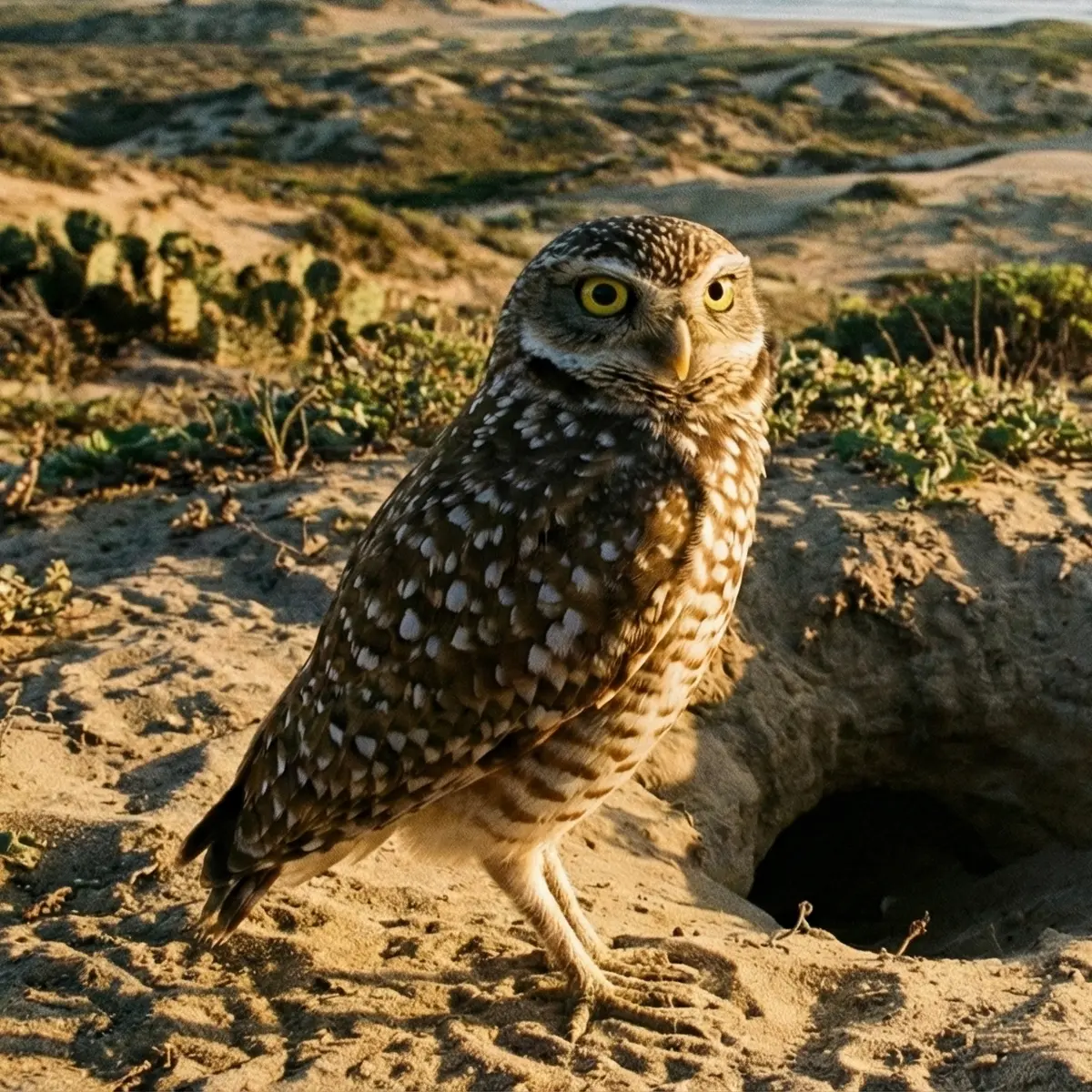
Finally, we descend to the arid coast, an ecosystem that at first glance seems inert, but is the home of the Burrowing Owl or Huerequeque (Athene cunicularia). Unlike other nocturnal raptors that live in trees, this small owl has made the ground its home, adapting perfectly to the coastal deserts of Peru.
Underground Life
This species nests in underground burrows, often reusing holes from other animals or digging their own. It is common to see them during the day, standing like statues on mounds of sand or walls of pre-Inca archaeological ruins, watching with their piercing yellow eyes. Their ability to control rodent and insect populations makes them fundamental allies of farmers in coastal valleys.
The Burrowing Owl is an example of resilience. Despite the urban expansion of cities like Lima or Trujillo, this bird has managed to survive on the margins, reminding us that Peruvian birds are present even near large cities, resisting and adapting to change.
Importance of Ecosystem Conservation
The future of these seven species, and the thousands of others that inhabit the territory, depends entirely on the conservation of their habitats. Deforestation in the Amazon, pollution of high-Andean rivers, and disorderly growth on the coast are latent threats.
The boom in Peruvian bird watching tourism plays a crucial role. By valuing living nature, economic incentives are created to protect forests and wetlands. Peru has the potential to be the world leader in ecotourism, but this requires a strategy that integrates local communities, ensuring that the benefits of tourism reach those who coexist daily with these species.
Protected areas, such as Manu National Park, Paracas National Reserve, and the Historic Sanctuary of Machu Picchu, are the last safe havens. Visiting these places with respect, following the rules, and hiring formal services is the best way to contribute so that future generations can also marvel at Peruvian birds.
Tips for Birdwatching in Peru
For those inspired to seek these winged jewels, here are some practical tips:
- The Right Equipment: You don’t need the most expensive gear, but decent binoculars (8×42 or 10×42) are essential. A field guide to Peruvian birds (physical or app) will help you identify what you see.
- The Magic Hour: Birds are most active early in the morning (just at dawn) and late in the afternoon. In the Amazon, dawn is a symphonic concert you cannot miss.
- Silence and Patience: Birdwatching is an exercise in meditation. Neutral-colored clothing (green, brown, gray) helps you go unnoticed.
- Hire Local Guides: Many guides in Peru are true encyclopedias of the jungle and sierra. They know the songs, nests, and schedules of the species. Furthermore, by hiring them, you support the local economy.
- Ethics: Never use recordings (playback) excessively to attract birds, as this stresses them. Keep your distance and respect nests.
Conclusion: An Invitation to Look at the Sky
Traveling through Peru in search of its birds is rediscovering the country. It is ceasing to look only at stone monuments to start looking at the life that flows around them. Peruvian birds are connectors: they link the coast with the sierra, the jungle with the sky, and the past with the present.
From the sacred flight of the condor that connects us with the Incas, to the frenetic dance of the Cock-of-the-rock that reminds us of the vitality of the jungle, each species tells a story. Peru offers an incomparable setting, a natural theater where the curtain never falls.
Whether you find yourself on the windy coasts of Paracas, in the deep canyons of Arequipa, or under the dense canopy of Madre de Dios, take a moment. Stop, keep silent, and look up. There, among the branches or soaring through the clouds, you will find the true owners of this territory. Peruvian birds are waiting to show you the magic of one of the most biodiverse countries on Earth. Are you ready to take flight?
OUR TIKTOK ACCOUNT
BLOG HOME:
https://bestmachupicchutours.com/blog
VISIT OUR SOCIAL MEDIA:
https://www.facebook.com/infocusco